Table of Contents
Jeans instability
Stars form from the condensation of gas clouds in the interstellar medium (ISM). A condensing cloud must become dense enough for starting nuclear reactions. As a cloud contracts, it sheds angular momentum and must overcome the pressure of magnetic fields inherent in the ionized gas of the ISM.
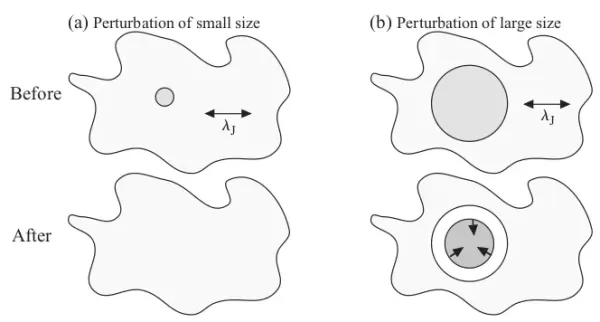
Many small perturbations (regions of higher density) can arise within a single cloud. The condition for such a perturbation to collapse inward (contracting toward its center) is that the magnitude of the gravitational potential energy \( E_p \) of an average atom in the cloud must exceed its kinetic energy \( E_k \):
\begin{equation} E_k \lesssim |E_p|. \end{equation}
If this inequality holds, self-gravity dominates over pressure, and the perturbation collapses. Otherwise, the region remains stable or disperses.
—
The kinetic energy per particle in a gas is roughly $$ E_k \sim m_H v^2, $$ where \( m_H \) is the hydrogen atom mass and \( v \) is the characteristic thermal velocity of the gas.
The gravitational potential energy per particle in a roughly uniform cloud of mass \( M \) and radius \( R \) is approximately $$ E_p \sim -\frac{G M m_H}{R}. $$
To compare these energies, note that the mass of the cloud can be written in terms of its density \( \rho \) as $$ M \approx \frac{4}{3}\pi R^3 \rho. $$
Substituting into the potential energy gives $$ |E_p| \sim \frac{G \left(\frac{4}{3}\pi R^3 \rho\right) m_H}{R} = \frac{4\pi}{3} G \rho R^2 m_H. $$
Setting the two energies in the inequality gives the approximate threshold for collapse:
$$ m_H v^2 \lesssim \frac{4\pi}{3} G \rho R^2 m_H. $$
Simplifying, we find
\begin{equation} R \gtrsim \frac{v}{\sqrt{G \rho}}. \end{equation}
This represents the critical radius above which gravity dominates over internal pressure.
—
Since the velocity \( v \) of gas particles is comparable to the speed of sound \( v_s \) in that gas, we define the Jeans length as:
\begin{equation} \lambda_J \approx \frac{v_s}{\sqrt{G \rho}}. \end{equation}
The Jeans length marks the minimum wavelength (or scale size) of a perturbation that will grow under its own gravity. Smaller perturbations (with \( \lambda < \lambda_J \)) are stabilized by pressure; larger ones (with \( \lambda > \lambda_J \)) collapse.
—
We can also derive a corresponding critical mass, known as the Jeans mass, by taking the mass contained within a sphere of radius \( \lambda_J / 2 \):
$$ M_J = \frac{4}{3}\pi \rho \left( \frac{\lambda_J}{2} \right)^3. $$
Substituting the expression for \( \lambda_J \), we obtain:
$$ M_J = \frac{4\pi}{3} \rho \left( \frac{v_s}{2\sqrt{G\rho}} \right)^3 = \frac{\pi^{3/2}}{6} \frac{v_s^3}{G^{3/2} \rho^{1/2}}. $$
Replacing \( v_s^2 \approx \frac{kT}{m_{\text{av}}} \), we get:
\begin{equation} M_J \approx \left( \frac{kT}{G m_{\text{av}}} \right)^{3/2} \frac{1}{\sqrt{\rho}}. \end{equation}
—
In the Cold Neutral Medium (CNM) of the ISM, the Jeans length is typically around 60 ly, and the Jeans mass is about \( 4000 \, M_\odot \). However, since CNM clouds are often smaller (around 30 ly), they do not collapse easily. If such a cloud were to shrink by a factor of four in size, its critical mass would drop by \( 4^3 = 64 \), allowing fragmentation into smaller clumps—each potentially giving birth to a star cluster.
In the Intergalactic Medium (IGM), where densities are far lower (\( n_H \sim 100 \, \text{m}^{-3} \)), the Jeans mass can reach \( 10^9 \, M_\odot \), typical of an entire galaxy.
Insights
The Jeans instability defines the precise point where self-gravity overcomes internal pressure. It determines whether a gas region will remain stable, oscillate, or collapse to form stars or galaxies.
- A region larger than \( \lambda_J \) cannot maintain equilibrium — pressure support is insufficient.
- A region smaller than \( \lambda_J \) remains stable against collapse.
- The Jeans mass provides a natural *mass scale* for star formation in any medium.
Thus, temperature (through sound speed) and density together decide whether a molecular cloud will fragment and give birth to stars or remain diffuse.
Inquiries
- Derive the Jeans length starting from the condition \( E_k \lesssim |E_p| \) and explain each physical step.
- Why does increasing temperature make it harder for a cloud to collapse?
- How does the Jeans mass change with decreasing density, and what does this imply for galaxy-scale structure formation?