Table of Contents
Heat transfer in stars
The energy produced in the core of a star by nuclear reactions must be transported outward through its layers until it escapes as radiation from the surface. This heat transfer occurs mainly by two mechanisms — radiative transfer and convective transfer — each operating in different regions depending on the temperature, density, and opacity of stellar material.
Radiative transfer
Consider two spherical layers inside a star separated by one mean free path,
$$ \Delta r = (\kappa\rho)^{-1}, $$
where \(\kappa\) is the opacity in m\(^2\) kg\(^{-1}\), the effective cross-section for absorption and scattering per unit mass. Opacity represents the resistance of the medium to the flow of radiation — the larger the opacity, the shorter the mean free path.
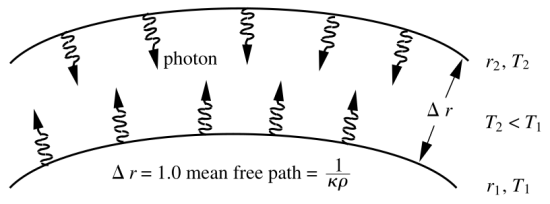
Each layer emits radiation as a blackbody with flux \(\mathscr{F} = \sigma T^4\), where \(\sigma\) is the Stefan–Boltzmann constant. The inner layer, at radius \(r_1\), is hotter (\(T_1 > T_2\)) and therefore radiates more intensely than the outer one. The net outward flux is
$$ \mathscr{F} = \sigma T_1^4 - \sigma T_2^4, $$
in units of W m\(^{-2}\). Multiplying this flux by the surface area \(4\pi r^2\) gives the luminosity through that spherical surface:
$$ L = -4\pi r^2 (\sigma T_1^4 - \sigma T_2^4) \approx -4\pi r^2 \Delta r \frac{d}{dr}(\sigma T^4), $$
where the minus sign indicates that energy flows outward as temperature decreases with radius. Replacing \(\Delta r = (\kappa\rho)^{-1}\) and differentiating gives
$$ L = -16\pi\sigma r^2 \frac{T^3}{\kappa\rho} \frac{dT}{dr}. $$
Rearranging,
$$ \frac{dT}{dr} = -\frac{1}{16\pi\sigma} \frac{\kappa\rho L}{T^3 r^2}. $$
This simplified relation underestimates the true gradient by about 30%. A more accurate treatment yields the radiative temperature gradient:
\begin{equation}\label{4} \dot{T}_r = \left.\frac{dT}{dr}\right\rvert_{\text{rad}} = -\frac{3}{64\pi\sigma} \frac{\rho\,L\,\kappa}{T^3 r^2}. \end{equation}
This equation shows that high luminosity \(L(r)\) or large opacity \(\kappa\) requires a steeper temperature gradient to maintain the same energy flow. The dependence of \(\dot{T}_r\) on \(L\) and \(\kappa\) is analogous to Ohm’s law:
- Luminosity \(L\) behaves like electric current \(I\),
- Opacity \(\kappa\) acts like resistance \(R\),
- Temperature difference \(\Delta T\) corresponds to potential difference \(\Delta V\).
Thus, radiative heat transport can be viewed as a kind of “thermal diffusion,” where higher resistance (opacity) requires a larger temperature drop to maintain the same energy flux.
Convective transfer
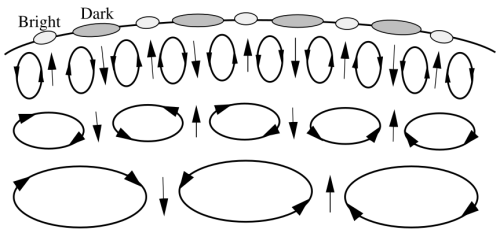
Where radiation becomes inefficient—due to high opacity or steep gradients—energy is instead carried by convection. Hot gas bubbles rise from deeper layers, cool near the surface, and sink again, creating circular convection currents. On the Sun’s photosphere these appear as bright granules, each about \(1000\) km across, as shown below.
This is a high-resolution video of the Sun’s surface taken by the Daniel K. Inouye Solar Telescope (DKIST). The granular pattern arises from the alternating hot upflows and cool downflows of convective motion.
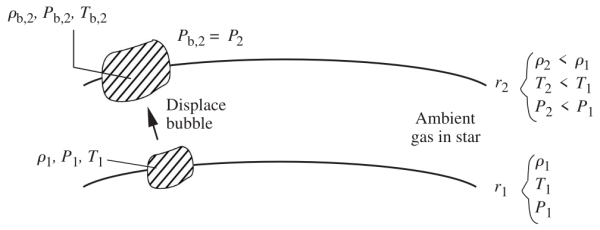
To understand when convection occurs, consider two neighboring spherical layers at radii \(r_1\) and \(r_2\), and a small bubble of gas initially identical to its surroundings at \(r_1\). As it rises, the ambient pressure decreases, causing the bubble to expand and cool adiabatically (\(\delta Q = 0\)). If the bubble becomes cooler (and hence denser) than its surroundings at \(r_2\), it sinks and convection ceases. If instead it remains hotter and less dense, it continues to rise, sustaining convection.
The criterion for convection is therefore:
$$ \dot{T}_r = \left.\frac{dT}{dr}\right\rvert_{\text{rad}} > \left.\frac{dT}{dr}\right\rvert_{\text{ad}} = \dot{T}_a. $$
In words: the radiative temperature gradient of the surroundings must be steeper than the adiabatic gradient of the bubbles.
Because \(\dot{T}_r \propto L\) while \(\dot{T}_a\) is independent of luminosity, higher luminosity promotes convection.
Adiabatic temperature gradient
Let us derive the expression for \(\dot{T}_a\). Starting from the thermodynamic identity
$$ \left.\frac{dT}{dr}\right\rvert_{\text{ad}} = \frac{\partial T}{\partial P}\frac{dP}{dr} + \frac{\partial T}{\partial S}\frac{dS}{dr} = \frac{dT}{dP}\frac{dP}{dr}, $$
since \(dS/dr = 0\) for an adiabatic process. For an ideal gas, \(PV^\gamma = \text{constant}\) where \(\gamma = C_P / C_V\). Differentiating \(PV = RT\) for one mole gives
$$ \frac{dT}{dP} = \left(1-\frac{1}{\gamma}\right)\frac{T}{P}. $$
Using the hydrostatic equilibrium equation \(dP/dr = -\rho g\), we find
$$ \dot{T}_a = \left(1-\frac{1}{\gamma}\right)\frac{T}{P}(-\rho g). $$
For a non-degenerate ideal gas \(P = \rho kT/m_{av}\), giving
\begin{equation}\label{5} \dot{T}_a = \left.\frac{dT}{dr}\right\rvert_{\text{ad}} = -\left(1-\frac{1}{\gamma}\right)\frac{m_{av}}{k}\,g. \end{equation}
This adiabatic temperature gradient is independent of luminosity and depends only on the local gravity \(g\) and gas composition through \(m_{av}\).
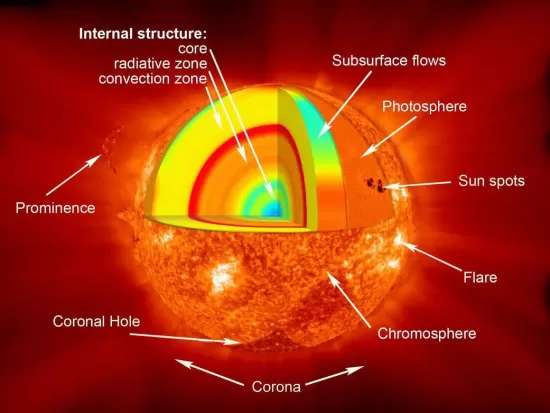
In the Sun, radiative transfer dominates up to about \(0.7\,R_\odot\), while the outer \(0.3\,R_\odot\) is convective. In the outer layers, the luminosity \(L(r)\) remains nearly constant (energy generation occurs only in the core), so the gradient \(\dot{T}_r \propto T^{-3}\) becomes steep as temperature falls toward the surface. When \(|\dot{T}_r| > |\dot{T}_a|\), convection begins.
Radiative and convective zones in stars
- Low-mass stars (\(<0.3\,M_\odot\)) are almost completely convective.
- Solar-type stars (~1 \(M_\odot\)) have a radiative core and convective envelope.
- Massive stars (>1.5 \(M_\odot\)) develop convective cores surrounded by radiative envelopes.
These internal zones strongly affect nuclear burning, element mixing, and stellar evolution.
Insights
- Radiative diffusion follows \(\dot{T}_r \propto L\kappa / (T^3 r^2)\); greater opacity or luminosity steepens the temperature gradient.
- Convection starts when the radiative gradient exceeds the adiabatic one.
- The adiabatic gradient depends only on gravity and composition, not on luminosity.
- Radiative and convective zones determine where a star is mixed or stratified.
- The Sun’s outer layers provide a clear example of convective heat transfer.
Inquiries
- Derive the radiative temperature gradient starting from the blackbody flux \(\mathscr{F}=\sigma T^4\).
- Explain physically why high opacity or luminosity promotes convection.
- How does the adiabatic gradient depend on composition and gravity?
- Describe the energy-transport structure of stars of different masses.
- What observational features of the Sun demonstrate convective motion?