Table of Contents
Fermi–Dirac statistics
The particles of the standard model of particle physics carry an intrinsic angular momentum known as spin, represented by the spin quantum number \(S\). The magnitude of the angular momentum vector is
$$ |\mathbf{L}|^2 = S(S+1)\hbar^2 $$
where \(\hbar = h/(2\pi)\) is the reduced Planck constant. Particles with half-integer spin (\(S = 1/2, 3/2, \dots\)) are called fermions, while those with integer spin (\(S = 0, 1, 2, \dots\)) are called bosons.
- Fermions: electrons, protons, neutrons, neutrinos, and any nucleus with an odd number of nucleons
- Bosons: photons, gluons, and nuclei such as \(^{4}\mathrm{He}\) and \(^{12}\mathrm{C}\)
Pauli exclusion principle
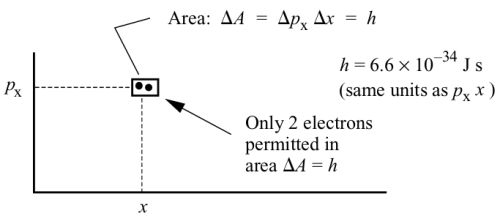
The Pauli exclusion principle states that no two identical fermions can occupy the same quantum state simultaneously. In the one-dimensional phase space shown above, an area element \(\Delta A = \Delta x\,\Delta p_x = h\) corresponds to one quantum state. Because electrons can have two spin orientations (up and down), at most two electrons can occupy a single phase-space cell.
In full six-dimensional phase space,
$$ \Delta x\,\Delta y\,\Delta z\,\Delta p_x\,\Delta p_y\,\Delta p_z = h^3, $$
and each quantum state can hold only two fermions of opposite spins.
This exclusion is purely quantum mechanical and has no classical analogue. It is the fundamental reason why matter resists compression at very high densities — the basis of degeneracy pressure.
From Maxwell–Boltzmann to Fermi–Dirac
At high temperature or low density, the number of available quantum states greatly exceeds the number of particles, and the exclusion principle has negligible effect. The particle distribution then follows Maxwell–Boltzmann statistics (MBS).
At very low temperatures or high densities, however, nearly all low-energy states become filled. This regime is described by Fermi–Dirac statistics (FDS), and the gas is said to be degenerate.
- In MBS: most particles occupy low-energy states, with a long tail at high energies.
- In FDS: all states below a certain limiting energy are filled, and very few particles occupy higher ones.
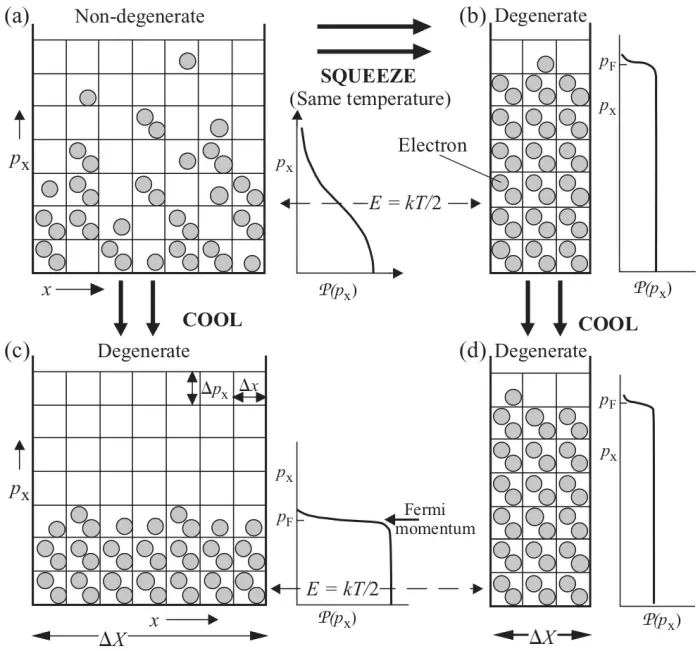
This complete filling of low-energy quantum states produces an effective pressure even at zero temperature — degeneracy pressure. It does not arise from thermal motion, but from the Pauli exclusion principle itself: compressing the gas forces fermions into higher momentum states, increasing the mean momentum and thus the pressure. This pressure supports compact stellar objects such as white dwarfs and plays a major role in the structure of brown dwarfs and planetary interiors.
The Fermi distribution
The Fermi–Dirac occupation probability for a particle of energy \(E\) at temperature \(T\) is
$$ F(E) = \frac{1}{e^{(E - E_F)/(kT)} + 1}, $$
where \(E_F\) is the Fermi energy, the highest occupied energy level at absolute zero (\(T = 0\)). At \(T = 0\), all states with \(E < E_F\) are filled (\(F = 1\)) and those with \(E > E_F\) are empty (\(F = 0\)), producing a sharp step in the distribution.

The figure above shows how \(F(E)\) changes with temperature. At \(T = 0\), the probability falls abruptly from 1 to 0 at \(E = E_F\). As the temperature increases, this transition becomes smoother — some particles gain energy and occupy states with \(E > E_F\), while some lower-energy states are vacated. Even for \(kT \ll E_F\), the curve remains steep near \(E_F\), meaning that most fermions remain below the Fermi energy.
The general phase-space distribution function is
$$ f_{FD} = \frac{2}{h^3}\,F(E), $$
where the factor \(2/h^3\) accounts for spin degeneracy (two spin orientations per quantum state). In the non-degenerate limit (\(E_F \ll kT\)), the exponential term dominates and Fermi–Dirac statistics reduce to Maxwell–Boltzmann statistics.
Degeneracy and Fermi momentum
In three dimensions, all occupied momentum states at \(T = 0\) form a sphere in momentum space of radius \(p_F\), called the Fermi momentum. The total number of electrons within this sphere is
$$ N_e = \frac{2}{h^3}\,\frac{4}{3}\pi p_F^3 V_x, $$
where \(V_x\) is the physical volume. The number density of electrons is then
$$ n_e = \frac{N_e}{V_x} = \frac{8\pi p_F^3}{3h^3}. $$
Rearranging gives the Fermi momentum in terms of the electron density:
$$ p_F = h\left(\frac{3n_e}{8\pi}\right)^{1/3}. $$
The corresponding Fermi energy is
$$ E_F = \frac{p_F^2}{2m_e} \quad \text{(nonrelativistic)}, \qquad E_F = \sqrt{p_F^2 c^2 + m_e^2 c^4} - m_e c^2 \quad \text{(relativistic)}. $$
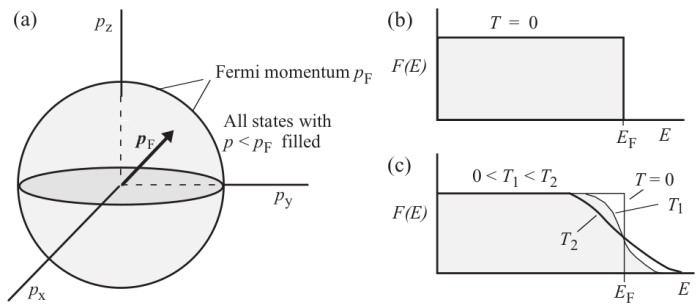
The Fermi sphere above visualizes all occupied quantum states in momentum space. Each point inside the sphere corresponds to a filled state with momentum \(\mathbf{p}\). At \(T = 0\), all states with \(|\mathbf{p}| < p_F\) are filled, and those outside remain empty. The radius \(p_F\) depends only on the density \(n_e\), and thus determines the Fermi energy and the magnitude of degeneracy pressure. Since degeneracy pressure depends only on \(n_e\), not on temperature, it persists even when \(T = 0\).
Insights
- Fermi–Dirac statistics describe particles that obey the Pauli exclusion principle.
- The Fermi energy \(E_F\) marks the transition between filled and empty states at \(T = 0\).
- Degeneracy pressure arises from the exclusion principle and increases with density, not temperature.
- The occupation probability \(F(E)\) softens with temperature but remains sharply defined near \(E_F\).
- The Fermi sphere in momentum space contains all filled states up to \(p_F\); its radius determines \(E_F\) and the strength of degeneracy pressure.
- FDS converges to MBS in the high-temperature or low-density limit.
Inquiries
- Derive the expression for \(p_F\) from the number density \(n_e\).
- Sketch \(F(E)\) at \(T = 0\) and at a finite temperature, labeling \(E_F\).
- Why does degeneracy pressure persist even when \(T = 0\)?
- How does the Fermi–Dirac distribution differ from the Maxwell–Boltzmann distribution?
- Explain the physical significance of the Fermi sphere and its radius \(p_F\).