1.1. The Four Fundamental Forces
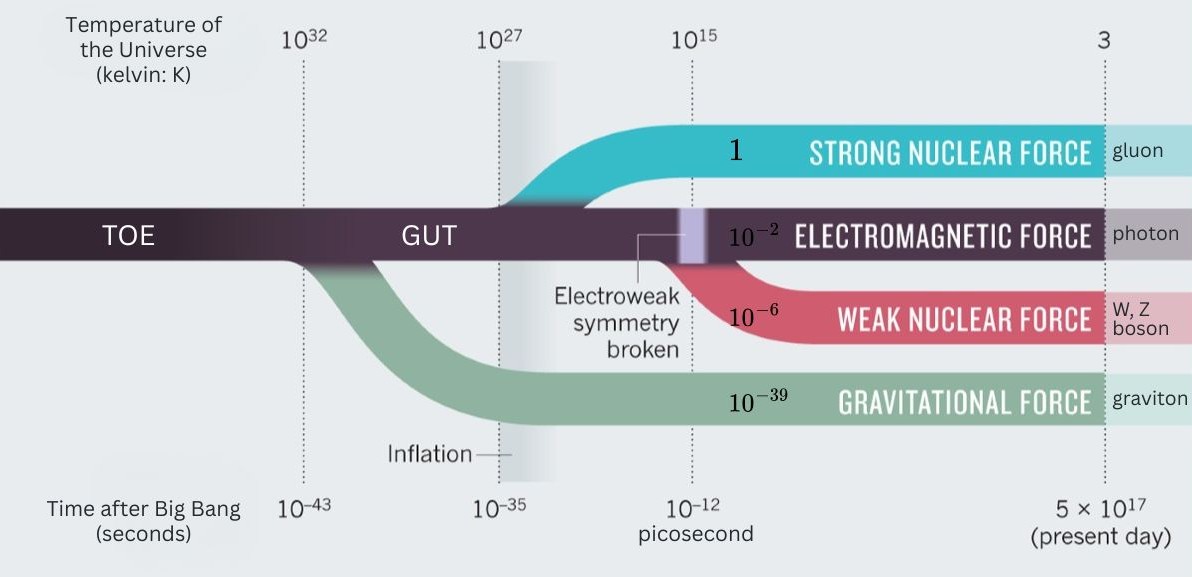
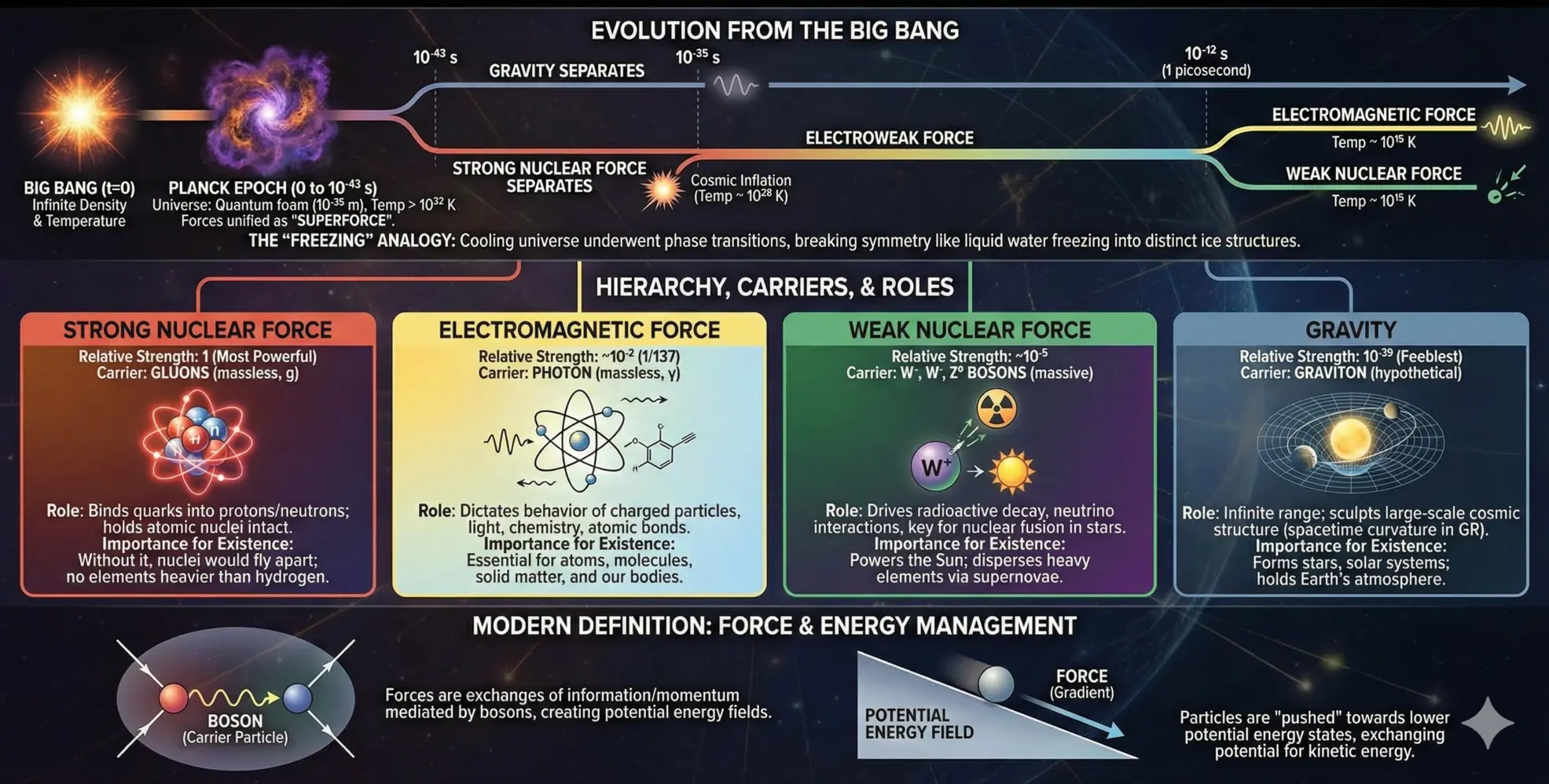
The evolution of the four fundamental forces began at the Big Bang ($t=0$), a state of infinite density and temperature. During the Planck Epoch ($0$ to $10^{-43}$ seconds), the universe was a chaotic quantum foam spanning merely $10^{-35}$ meters (the Planck length) with temperatures exceeding $10^{32}$ Kelvin, where all forces were unified in a single “Superforce”. At $10^{-43}$ seconds, Gravitational Force or gravity became the first to separate from the others. Around $10^{-35}$ seconds, as the universe cooled to $10^{28}$ Kelvin, the Strong Nuclear Force separated, an event associated with the release of energy that drove cosmic inflation. Finally, at $10^{-12}$ seconds ($1$ picosecond) and $10^{15}$ Kelvin, the Electroweak force split into Electromagnetic Force and the Weak Nuclear Force.
Physicists describe the separation of these forces using the analogy of “freezing” or a phase transition, similar to liquid water turning into ice. In the extreme heat of the early universe, the forces were symmetric and indistinguishable, much like the uniformity of liquid water. As the cosmos expanded and cooled, it passed through critical thresholds where this symmetry was spontaneously broken. Just as cooling water releases latent heat and crystallizes into distinct structures, the cooling universe underwent phase transitions that allowed the unified forces to “freeze out” into the distinct, asymmetric identities we observe today. This process explains why the universe currently operates under four distinct sets of physical laws rather than one.
The four fundamental forces are defined by a vast hierarchy of relative strengths and distinct carrier particles. At the top of this hierarchy sits the Strong Nuclear Force, the most powerful interaction with a relative strength of $1$, mediated by the exchange of massless gluons. Far weaker is Electromagnetism, with a strength of approximately $10^{-2}$ (or $1/137$), which is efficiently carried by the photon. The Weak Nuclear Force drops significantly to a strength of roughly $10^{-5}$ and relies on the massive $W^{+}$, $W^{-}$, and $Z^{0}$ bosons to mediate interactions. Finally, Gravity is the feeblest force by far at a strength of $10^{-39}$; while it is hypothetically carried by the graviton, it remains unique in its theoretical description.
Despite these differences in power, each force governs a critical aspect of nature’s machinery. The Strong Nuclear Force acts as the universal glue, binding quarks into protons and neutrons and holding atomic nuclei intact against repulsive odds. Electromagnetism dictates the behavior of electrically charged particles and light, essentially forming the rules for chemistry and atomic bonds. The Weak Nuclear Force drives essential transmutation processes like radioactive decay and neutrino interactions, playing a key role in nuclear fusion. Meanwhile, Gravity, though weak, possesses an infinite range that allows it to sculpt the large-scale structure of the cosmos, described not just as a force but as the curvature of spacetime itself in general relativity.
Our existence depends entirely on the specific roles of each force. Without Gravity, the Earth would not hold an atmosphere, nor would the Sun and Solar System have formed to provide a home for life. Without Electromagnetism, electrons would not bind to nuclei; therefore, atoms, molecules, and solid matter—including our own bodies—would disintegrate. Without the Strong Force, the nuclei of atoms would fly apart due to the electric repulsion of protons, preventing the existence of any element heavier than hydrogen. Without the Weak Force, the nuclear fusion reactions (proton-proton chain) that power the Sun would not occur, nor would the heavy elements essential for life be dispersed through supernovae.
In modern physics, a force is not merely a “push” or “pull” but the mechanism by which the universe manages energy distribution. At the quantum level, forces are exchanges of information and momentum mediated by “carrier” particles called bosons, creating fields that permeate space and store potential energy. The relationship between force and energy can be visualized as a slope: a force is effectively the “gradient” of a potential energy field. Just as a ball rolls down a hill to minimize its gravitational potential energy, particles are “pushed” by forces toward states of lower potential energy. Thus, when a particle interacts with a field, it exchanges potential energy for kinetic energy, manifesting as the physical force we observe acting over a distance.